Choosing the right SSL certificate type affects your security posture, user trust signals, and operational costs. The three main types offer different levels of identity verification, visual trust indicators, and price points.
Understanding these differences helps you select certificates appropriate for each use case without overspending on unnecessary validation levels.
What are the SSL Certificate Types?
Domain Validation (DV) Certificates
DV certificates verify only that you control the domain. Validation happens through:
- Email verification
- DNS record creation
- File upload to the web server
Issuance time: Minutes to hours
DV certificates display the same padlock icon as other types but don't include organization information in the certificate details.
Organization Validation (OV) Certificates
OV certificates verify both domain control and that the requesting organization legally exists. CAs confirm organization details through:
- Business registries
- Phone verification
- Other validation checks
Issuance time: 1-3 days
The certificate includes verified organization name and location, visible when users inspect certificate details.
Extended Validation (EV) Certificates
EV certificates require the most rigorous verification:
- Confirming legal existence
- Verifying physical address
- Confirming operational existence
- Verifying the certificate requester is authorized to act for the organization
Issuance time: 1-2 weeks
Why Certificate Type Choice Matters
Encryption is Identical
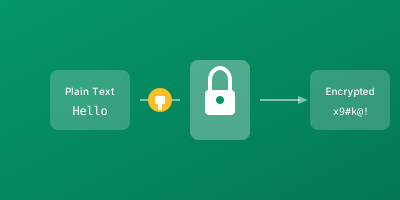
All three certificate types provide the same level of encryption. The cryptographic protection is identical across DV, OV, and EV.
The difference lies in identity assurance: how confident can users be about who operates the website they're connecting to?
When Domain Recognition is Enough
DV certificates prove you're connecting to the intended domain but say nothing about who owns it. This is sufficient for most websites where domain recognition provides adequate trust.
Users trust "google.com" because they recognize the domain, not because of certificate details.
When Organizational Verification Adds Value
OV and EV certificates add organizational verification. This is potentially valuable for:
- New businesses without established domain recognition
- Financial services
- Situations where users need assurance about the operating entity
Cost Comparison
| Certificate Type | Typical Cost | Validation Time |
|---|---|---|
| DV | Free to $50/year | Minutes to hours |
| OV | $50-200/year | 1-3 days |
| EV | $100-500+/year | 1-2 weeks |
The validation process for OV/EV also requires staff time to complete verification steps.
Certificate Type Comparison
Validation Process
| Type | Requirements | Timeline |
|---|---|---|
| DV | Domain control proof only (automated) | Minutes |
| OV | Organization verification + manual CA review | 1-3 days |
| EV | Extensive verification, legal docs, phone callbacks | 1-2 weeks |
Trust Indicators
- All types: Display the padlock icon
- OV and EV: Include organization details in certificate information (viewable by clicking the padlock)
- EV formerly: Displayed green address bars or organization names (most browsers have removed these distinctions)
Use Case Recommendations
| Use Case | Recommended Type |
|---|---|
| Blogs, personal sites | DV |
| Internal tools | DV |
| Business websites | OV |
| E-commerce | OV or DV |
| B2B services | OV |
| Financial institutions | EV (if required) |
| Government sites | EV (often required) |
Wildcard Availability
- DV certificates: Can be issued as wildcards (
*.example.com) - OV certificates: Can be issued as wildcards
- EV certificates: Cannot be wildcards (require separate certificates for each FQDN)
Selecting the Right Certificate Type
For Most Websites: DV
DV certificates provide appropriate security at minimal cost. Let's Encrypt's free DV certificates with automated renewal have made HTTPS accessible to everyone and are suitable for the vast majority of use cases.
# Get a free DV certificate with Let's Encrypt
certbot certonly --webroot -w /var/www/html -d example.com -d www.example.com
Consider OV When:
- Displaying verified organization information in certificate details adds value
- Your industry expects higher assurance levels
- Users who check certificate details matter to your business
Choose EV Only When:
- Regulations require it
- Contractual obligations specify EV
- You've specifically determined that additional trust signals provide meaningful value
Conclusion
DV, OV, and EV certificates all provide the same encryption strength. They differ only in identity verification depth and associated trust signals.
Key Takeaways
- For most use cases: DV certificates from reputable CAs (including free options like Let's Encrypt) are entirely appropriate
- OV and EV: Add organizational verification that may matter for specific industries but don't improve security
- Make decisions based on actual trust requirements and user needs, not marketing materials suggesting more expensive means more secure
Related Guides
- SSL Certificate Monitoring: Complete Guide — Monitor all certificate types from a single dashboard
- SSL Chain Validation Explained — Understand how different certificate types build trust chains
- Let's Encrypt Monitoring — Automate DV certificate management with Let's Encrypt
- SSL Security Headers Guide — Configure security headers regardless of certificate type