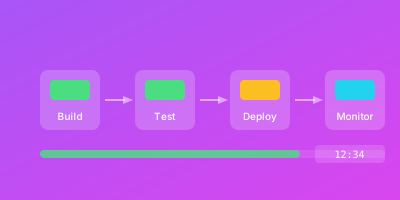
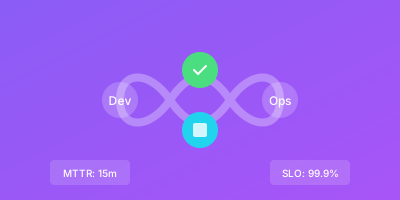
In the fast-paced world of software delivery, DevOps monitoring has become the cornerstone of operational excellence. Organizations that master monitoring achieve 60% faster incident resolution and 50% fewer outages.
Yet many teams struggle to implement a cohesive monitoring strategy. They end up with fragmented tools, alert noise, and blind spots that leave critical issues undetected.
What is DevOps Monitoring?
DevOps monitoring is the practice of collecting, analyzing, and acting on data from every stage of the software development and operations lifecycle. Unlike traditional monitoring that focused primarily on infrastructure health, DevOps monitoring encompasses the entire delivery pipeline.
The Three Pillars of Observability
At its core, DevOps monitoring integrates three key observability pillars:
- Metrics - Quantitative measurements of system behavior over time
- Logs - Detailed event information for troubleshooting and auditing
- Traces - Request flows through distributed systems, revealing performance bottlenecks
Beyond Technical Metrics
Modern DevOps monitoring extends beyond technical metrics to include:
- Business KPIs and revenue impact
- Deployment frequency tracking
- Change failure rates
- Mean time to recovery (MTTR)
This holistic approach aligns technical operations with business outcomes, enabling data-driven decision making at every level.
Shift-Left Monitoring
The shift-left philosophy encourages monitoring implementation earlier in the development cycle. Developers integrate monitoring into their code and create custom metrics for application-specific insights.
# Example: Prometheus metrics in application code
metrics:
  - name: http_requests_total
    type: counter
    labels:
      - method
      - endpoint
      - status_code
  - name: request_duration_seconds
    type: histogram
    buckets: [0.1, 0.5, 1, 2, 5]
Why DevOps Monitoring Strategy Matters
A well-defined monitoring strategy is the difference between reactive firefighting and proactive operations. Research from the DORA State of DevOps Report consistently shows that elite performers invest heavily in comprehensive monitoring.
Challenges Without a Strategy
Without a cohesive strategy, teams face critical challenges:
- Tool sprawl - Overlapping functionality, increased costs, and fragmented visibility
- Alert fatigue - Poorly configured thresholds causing important notifications to be ignored
- Blind spots - Monitoring gaps allowing issues to escalate into major incidents
- Correlation difficulty - Lack of context makes root cause analysis time-consuming
The Business Impact
Beyond direct financial impact, reliability issues:
- Erode customer trust
- Damage brand reputation
- Increase customer churn
Benefits of Strategic Monitoring
A strategic approach delivers measurable benefits:
- Reduced mean time to detection through intelligent alerting
- Faster mean time to resolution through correlated data
- Improved deployment confidence through comprehensive checks
- Enhanced collaboration through shared visibility
How to Build Your DevOps Monitoring Strategy
Building an effective strategy requires a systematic approach that aligns technical capabilities with organizational objectives.
Step 1: Define Goals and Success Metrics
Start by answering: What does good look like for your organization?
Consider these key metrics:
- Deployment frequency targets
- Change failure rate thresholds
- Mean time to recovery goals
- Customer-facing availability targets
Step 2: Map Your Monitoring Coverage
Map coverage across four key domains:
| Domain | What to Monitor |
|---|---|
| Infrastructure | Servers, containers, networks, cloud resources |
| Application Performance | Response times, error rates, throughput |
| Pipeline | Build times, test coverage, deployment success |
| User Experience | Real user metrics, synthetic transactions, journey completion |
Step 3: Select Your Monitoring Stack
Consider your organizational requirements when selecting tools:
# Example monitoring stack configuration
monitoring_stack:
  metrics:
    - prometheus
    - grafana
  logs:
    - elasticsearch
    - logstash
    - kibana
  tracing:
    - jaeger
  # Or use integrated platforms:
  # - datadog
  # - new_relic
  # - dynatrace
Key questions to answer:
- Managed services or self-hosted solutions?
- How do tools integrate with your existing ecosystem?
- What level of customization is required?
Step 4: Implement Progressively
Implementation steps:
- Identify your most critical services
- Deploy basic monitoring coverage
- Create meaningful dashboards for different audiences
- Configure alerts based on SLOs, not arbitrary thresholds
- Expand to additional services
Step 5: Build Feedback Loops
Connect monitoring data to development processes:
- Integrate insights into sprint retrospectives
- Use production data to inform architectural decisions
- Continuously refine alerting based on team feedback
- Learn from every incident
DevOps Monitoring Best Practices
Successful implementation follows several proven best practices.
Adopt SLOs as Your Alerting Foundation
Rather than alerting on every metric deviation, define meaningful SLOs that reflect user experience.
# Example SLO configuration
slos:
  - name: api_availability
    target: 99.9%
    window: 30d
    indicator:
      type: availability
      good_events: successful_requests
      total_events: total_requests

  - name: api_latency
    target: 95%
    window: 30d
    indicator:
      type: latency
      threshold: 200ms
      percentile: p95
This approach dramatically reduces alert noise while ensuring critical issues receive attention.
Implement Monitoring as Code
Version control your dashboards, alert rules, and monitoring configurations:
# Structure for monitoring as code
monitoring/
├── dashboards/
│   ├── service-overview.json
│   └── infrastructure.json
├── alerts/
│   ├── critical.yaml
│   └── warning.yaml
└── terraform/
    └── monitoring.tf
Benefits include:
- Peer review for monitoring changes
- Rollback capabilities
- Consistent monitoring across environments
Design for Correlation
Implement consistent tagging and labeling across all monitoring data:
# Example: Consistent labels across metrics
labels:
  service: payment-api
  environment: production
  team: platform
  version: v2.3.1
Use trace IDs to connect logs, metrics, and traces for individual requests.
Embrace Automation
Create runbooks for known issues and progressively automate routine remediations:
- Start with automated diagnostics and information gathering
- Advance to automated remediation for well-understood problems
- Implement self-healing for predictable failure modes
Foster Observability Culture
Make monitoring a shared responsibility:
- Include monitoring requirements in definition of done
- Conduct regular monitoring reviews
- Celebrate improvements in detection and resolution times
Conclusion
Building an effective DevOps monitoring strategy is a journey, not a destination. Start with clear objectives aligned to business outcomes and continuously refine your approach.
Next Steps
- Assess your current monitoring maturity
- Identify the biggest gaps in coverage or capability
- Create a prioritized roadmap for improvement
- Start implementing with your most critical services
With consistent effort and the practices outlined in this guide, you'll build monitoring that enables faster, safer, and more confident software delivery.
Related Guides
- SRE Golden Signals Monitoring — Build your strategy around the four golden signals
- Infrastructure as Code Monitoring — Monitor infrastructure changes as part of your DevOps strategy
- CI/CD Pipeline Monitoring — Include deployment pipeline monitoring in your framework
- Complete Guide to Uptime Monitoring — Integrate uptime monitoring into your DevOps monitoring strategy