APIs are the backbone of modern software architecture. They enable communication between services, mobile apps, third-party integrations, and AI applications.
As organizations adopt microservices and distributed systems, the number of APIs to monitor has grown exponentially. A failure in a single API can cascade through dependent services, affecting users across multiple touchpoints.
What is API Monitoring?
API monitoring is the practice of continuously testing and measuring API endpoints. It ensures they are available, performant, and returning correct responses.
Key Dimensions of API Monitoring
- Availability monitoring: Is the API responding?
- Performance monitoring: How quickly does it respond?
- Functional monitoring: Does it return correct data?
- Security monitoring: Is it vulnerable to attacks?
Modern API monitoring involves synthetic testing, where automated tests simulate real API calls and verify responses against expected outcomes.
What Should You Monitor?
Effective API monitoring covers the full API lifecycle:
- Endpoint availability
- Authentication and authorization flows
- Request/response validation
- Error rate tracking
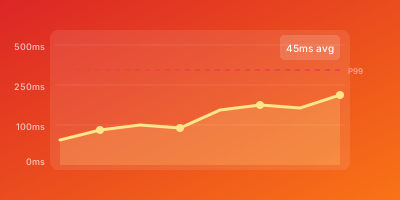
- Latency percentiles (not just averages)
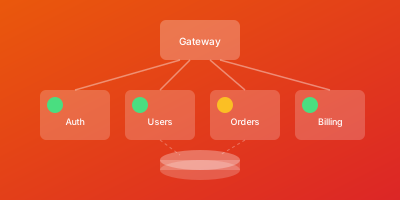
- Dependency health
- Rate limit status
- Version compatibility
Why API Monitoring is Critical
Multiplied Impact
APIs often serve as the single point of integration for multiple consumers. A public API might serve mobile apps, web applications, third-party integrations, and internal services simultaneously.
Downtime or degradation affects all these consumers, multiplying the impact of any issue.
User Expectations
Performance expectations have increased significantly. Users expect sub-second responses, and slow APIs directly impact user experience metrics like Core Web Vitals.
Business-Critical Dependencies
APIs are increasingly business-critical:
- E-commerce relies on payment and inventory APIs
- Healthcare depends on patient data APIs
- Financial services require real-time market data APIs
In these contexts, API failures translate directly to business disruption.
Diagnostic Complexity
The complexity of modern architectures makes API issues harder to diagnose. A request might traverse multiple services, each with their own APIs, before returning a response.
Comprehensive monitoring provides the visibility needed to pinpoint issues in complex service meshes.
How to Implement Effective API Monitoring
Categorize APIs by Criticality
Not all APIs require the same monitoring intensity:
| API Type | Check Interval | Alert Priority |
|---|---|---|
| Payment processing | 30 seconds | Immediate |
| User authentication | 1 minute | High |
| Internal reporting | 5 minutes | Standard |
Design monitoring that reflects business impact.
Implement Multi-Layer Monitoring
For each API, implement comprehensive checks:
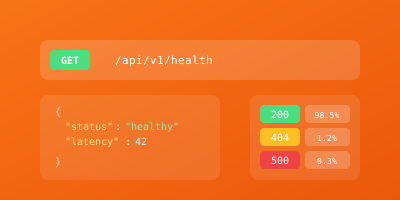
- Availability checks: Verify the endpoint responds with expected status codes
- Response time monitoring: Track latency percentiles (p50, p95, p99) rather than just averages
- Content validation: Confirm response bodies match expected schemas
Monitor from Multiple Locations
APIs can have location-specific performance characteristics due to:
- Network routing
- Regional server deployment
- CDN behavior
Multi-location monitoring identifies geographic issues and provides realistic latency measurements for global users.
Create API-Specific Assertions
Validate business logic, not just technical responses. For an inventory API:
{
  "assertions": [
    { "field": "stock_quantity", "check": ">=", "value": 0 },
    { "field": "product_id", "check": "matches", "pattern": "^PRD-[0-9]{6}$" },
    { "field": "price", "check": "between", "min": 0.01, "max": 999999.99 }
  ]
}
These semantic checks catch issues that pass basic response validation.
Set Up Dependency Mapping
Understand how API failures cascade. When an API fails, automatically check its dependencies to accelerate root cause analysis.
Alerting should consider both the failing API and its downstream impact.
API Monitoring Best Practices
Monitor Authentication Flows Explicitly
Many API issues manifest as authentication failures. A working health check endpoint does not guarantee that authenticated requests succeed.
# Test full authentication sequence
curl -X POST https://api.example.com/auth/token \
  -d '{"username":"test","password":"secret"}' \
  -H "Content-Type: application/json"

# Use token for authenticated request
curl https://api.example.com/protected/resource \
  -H "Authorization: Bearer $TOKEN"
Regularly test full authentication sequences including token refresh.
Implement Progressive Alerting
Configure alert escalation based on severity and duration:
- Single failed check: Log for investigation
- 3 consecutive failures: Page on-call engineer
- 5+ minute sustained failure: Escalate to incident management
Track Error Budgets
If your API has a 99.9% availability SLO, monitor remaining error budget consumption. Alert when approaching budget limits, enabling proactive intervention before SLO breaches.
Monitor Rate Limit Usage
APIs hitting rate limits appear to fail from the consumer's perspective. Track:
- Your consumption of third-party API rate limits
- Your consumers' usage of limits you enforce
Version Monitoring
For APIs with multiple versions:
- Track usage distribution across versions
- Monitor deprecated version usage
- Ensure new versions meet the same performance characteristics
Document Coverage and Gaps
Maintain a catalog of all APIs with their monitoring status. This helps identify blind spots and prioritize monitoring improvements.
Conclusion
API monitoring in 2026 requires comprehensive strategies that address availability, performance, correctness, and security across diverse API styles.
As APIs become more critical to business operations and user experiences, investing in robust monitoring infrastructure pays dividends in reliability and customer satisfaction.
Getting Started
- Start with your most critical APIs
- Implement multi-dimensional monitoring that validates both technical and business expectations
- Expand coverage systematically using API catalogs and dependency maps
The monitoring foundation you build will enable confident deployment and rapid incident response as your API ecosystem grows.
Related Guides
- API Response Time Optimization — Optimize the performance metrics your monitoring reveals
- REST API Health Check Endpoints — Design health check endpoints for effective API monitoring
- API Rate Limiting Monitoring — Monitor rate limits to protect your APIs from abuse
- SRE Golden Signals Monitoring — Apply the four golden signals to your API monitoring strategy